
How Does a Full Arch Reconstruction Work?
Full arch reconstruction involves replacing or rebuilding an entire arch of teeth in the upper jaw, lower jaw, or both. This comprehensive approach is often necessary for patients who have lost most or all of their teeth due to trauma, decay, or periodontal disease. Unlike partial solutions like dentures or individual dental implants, a full arch reconstruction addresses the entire arch, creating a unified, natural-looking set of teeth that functions like real teeth.
The most common method for full arch reconstruction involves using dental implants to secure prosthetic teeth in place. These implants act as artificial roots, providing a stable foundation for a full arch of new teeth, whether in the form of a fixed bridge or a removable denture.
Who Is a Candidate for Full Arch Reconstruction?
Full arch reconstruction is an ideal solution for individuals who have experienced significant tooth loss or damage, making it difficult to chew, speak, or smile with confidence. It’s typically recommended for patients with:
- Multiple Missing Teeth: If you have lost several teeth in one or both arches due to injury, decay, or gum disease, full arch reconstruction can replace these missing teeth with a permanent solution.
- Severe Tooth Damage: Patients with extensive tooth decay, fractures, or worn-down teeth may benefit from a full arch reconstruction to restore the functionality and appearance of their smile.
- Loose or Ill-Fitting Dentures: If you currently wear dentures but struggle with discomfort or slippage, full arch reconstruction can provide a more stable, comfortable alternative.
During your initial consultation at Comprehensive Dental Implant Center, Dr. Hendrickson will evaluate your oral health and determine if full arch reconstruction is the right solution for you.
The Full Arch Reconstruction Process
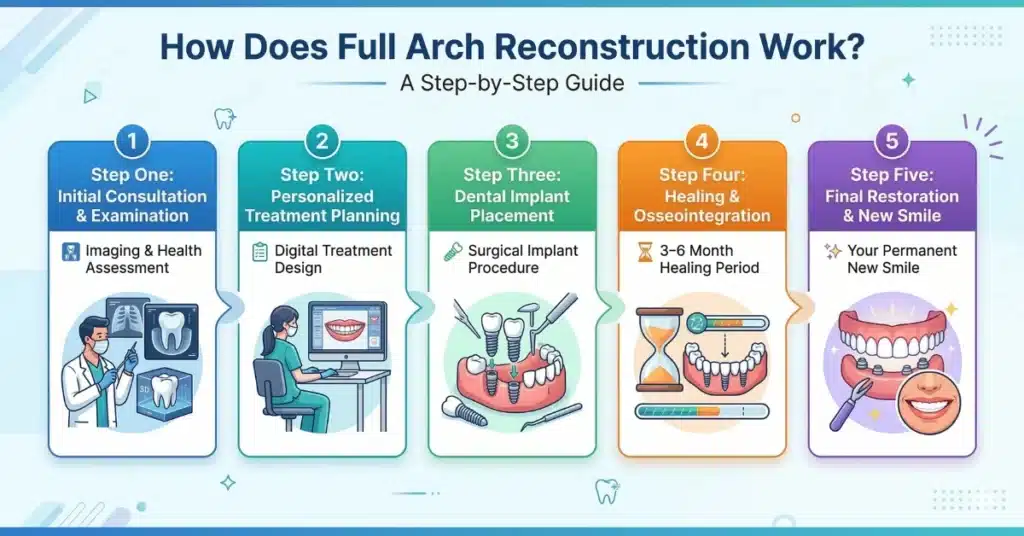
The full arch reconstruction process is a multi-step procedure designed to ensure that your new smile is both functional and aesthetically pleasing. Here’s what you can expect during each phase of treatment:
1. Initial Consultation and Examination
The first step in a full arch reconstruction is a comprehensive consultation and examination with Dr. Hendrickson. During this appointment, your dental history, overall health, and specific concerns will be discussed. Dr. Hendrickson will perform a thorough examination, which may include X-rays or 3D imaging to assess the condition of your jawbone and surrounding tissues.
This evaluation helps determine whether you are a good candidate for dental implants, as a sufficient amount of healthy bone is necessary to support the implants. If you’ve experienced bone loss due to missing teeth, a bone graft may be recommended to rebuild the jawbone and provide a strong foundation for the implants.
2. Treatment Planning
Once it’s determined that full arch reconstruction is the best course of action, Dr. Hendrickson will develop a personalized treatment plan tailored to your needs. This plan will outline the number of implants required, the type of prosthetic teeth (fixed bridge or removable denture), and the overall timeline for each stage of the procedure. Advanced digital technology ensures precise planning, allowing Dr. Hendrickson to create a restoration that fits seamlessly with your natural facial structure.
3. Dental Implant Placement
The cornerstone of full arch reconstruction is the placement of dental implants. Typically, four to six implants are strategically placed in the jawbone to support a full arch of prosthetic teeth. These implants are made of biocompatible titanium and act as artificial tooth roots, providing the necessary stability for your new teeth.
During the procedure, Dr. Hendrickson will make small incisions in the gum tissue and insert the implants into the jawbone. Local anesthesia or sedation is used to ensure your comfort throughout the surgery. Once the implants are placed, the gums are sutured, and a temporary prosthesis may be attached while the implants heal and integrate with the bone.
4. Healing and Osseointegration
After the implants are placed, a healing period of several months is required to allow the implants to fuse with the jawbone. This process, known as osseointegration, is critical for the long-term success of the implants. During this time, the implants bond with the bone, creating a secure and stable foundation for the final prosthetic teeth.
5. Final Restoration
Once osseointegration is complete, Dr. Hendrickson will take detailed impressions of your mouth to create your final set of prosthetic teeth. These custom-made teeth will be designed to match the shape, color, and size of your natural teeth, ensuring a natural and beautiful result.
Let’s Rebuild That Smile!
Full arch reconstruction is a life-changing procedure for those suffering from extensive tooth loss or damage. At Comprehensive Dental Implant Center in Henderson, Dr. Hendrickson and his team are committed to providing high-quality, personalized care for their patients. If you’re considering full arch reconstruction in Henderson and Las Vegas, contact us today to schedule a consultation and learn more about how this transformative procedure can restore your smile and improve your quality of life.
The content on this blog is not intended to be a substitute for professional medical advice, diagnosis, or treatment. Always seek the advice of qualified health providers with questions you may have regarding medical conditions.
Full Arch Restoration FAQs
How long does full arch reconstruction take from start to finish?
The entire process typically takes 6 to 12 months. This includes the initial consultation, implant placement, and the osseointegration healing period — which alone can take 3 to 6 months — before the final prosthetic teeth are attached. Timelines vary based on whether bone grafting is needed.
Is full arch reconstruction painful?
The procedure is performed under local anesthesia or IV sedation, so patients feel little to no pain during surgery. Post-operative soreness and swelling are normal and manageable with prescribed or over-the-counter pain relief. Most patients report the discomfort is far less than anticipated.
How many implants are needed for a full arch reconstruction?
Typically, four to six dental implants are placed per arch. This is enough to anchor a full bridge of prosthetic teeth securely. The exact number depends on bone density, jaw anatomy, and whether a fixed bridge or removable denture is being used.
What is osseointegration and why does it matter?
Osseointegration is the process by which titanium implants fuse with the jawbone after placement. It’s critical because it creates the stable foundation that makes implant-supported teeth function like natural roots. Without successful osseointegration, the final restoration cannot be securely attached.
Can I get full arch reconstruction if I’ve experienced bone loss?
Yes, in many cases. Patients with bone loss may require a bone graft prior to implant placement. The graft rebuilds jawbone volume and density, creating a strong enough foundation to support the implants. Dr. Hendrickson will assess your bone health during the initial consultation.
How is full arch reconstruction different from dentures?
Unlike traditional dentures, full arch reconstruction uses dental implants anchored into the jawbone. This eliminates slippage, improves chewing efficiency, and prevents bone loss over time. The result is a permanent, stable, natural-looking restoration rather than a removable appliance.