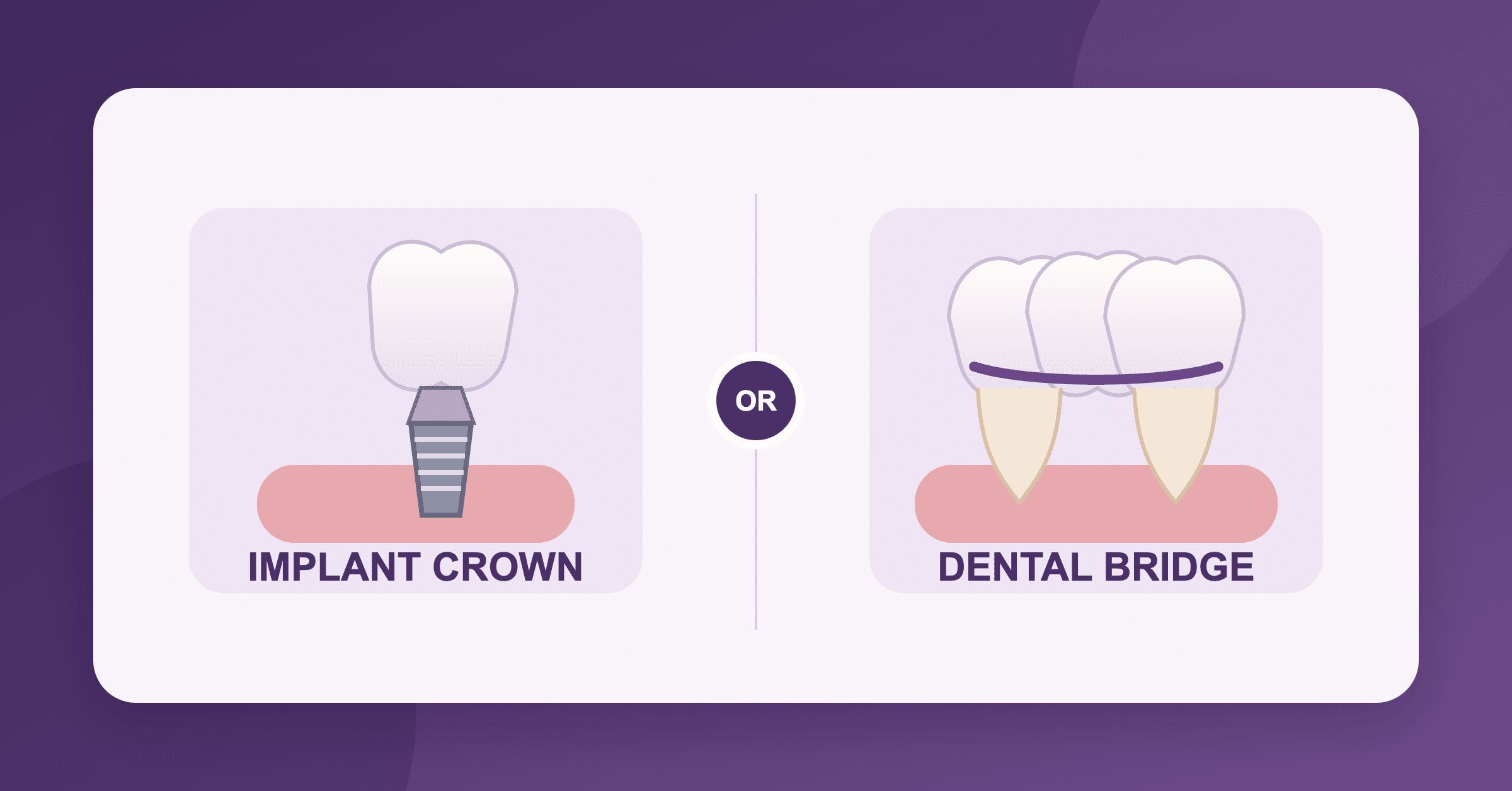
Single Tooth Implant vs. Dental Bridge: Which Is Right for You?
Before comparing a single tooth implant with a dental bridge, inspect the teeth beside the gap. Preparing healthy, mostly untouched teeth for bridge crowns carries a cost that an implant avoids. Teeth that already need crowns change that calculation. Bone, health history, and timing remain part of the decision.
Start with the neighboring teeth
The neighboring teeth often settle the first question. An implant replaces the missing tooth without asking sound teeth to support it. When one or both neighboring teeth need full-coverage crowns anyway, they may also serve as bridge supports. The gap looks the same; the work assigned to those teeth is different.
Single Tooth Implant vs. Dental Bridge: Quick Comparison
| Decision factor | Single tooth implant | Conventional dental bridge |
|---|---|---|
| Support | An implant in the jaw supports one crown. | Prepared teeth beside the gap support a connected false tooth. |
| Neighboring teeth | Usually not prepared to hold the implant crown. | Usually shaped for crowns that retain the bridge. |
| Timeline | Includes surgery and integration; a temporary tooth may be used. | Often completed on a restorative schedule after the support teeth are prepared. |
| Cleaning | Brush and clean around the implant crown and gumline. | Brush normally and thread floss or another tool beneath the connected pontic. |
| Cost structure | Implant placement, abutment, and crown, plus any site preparation. | Connected crowns/pontic, support-tooth treatment, and possible buildup or root-canal needs. |
| Repair path | The fixture, connector, crown, and tissue can be evaluated separately. | A problem with one support tooth can affect the connected bridge. |
| Durability dependency | The fixture and crown have separate maintenance and replacement cycles. | The bridge’s outlook depends on both support teeth and the connected restoration. |
| Key question | Is the site a good candidate for an independent implant crown? | Do the support teeth make a tooth-supported plan sensible? |
How a Single Tooth Implant Replaces the Missing Tooth
You see the crown, but two other parts sit below it. The implant fixture is placed in the jaw, and an abutment connects that fixture to the custom crown. The American Dental Association’s implant guidance describes the healing process, called osseointegration, in which bone heals around the implant. The timing of the final restoration depends on the site and the treatment plan.
Position is planned backward from the tooth that needs to be replaced. The fixture has to clear nearby roots while leaving room for a crown, healthy gum contours, and a workable bite. Photographs and ordinary X-rays may be enough; sometimes a 3D scan is needed. A temporary tooth can fill the space during healing, though it may not attach to the new implant.
How a Tooth-Supported Bridge Fills the Gap
A conventional bridge joins three or more units. Crowns go over the teeth beside the gap, and the false tooth between them is called a pontic. After the support teeth are shaped and recorded, a temporary bridge may cover the area while the laboratory makes the final one. The Delta Dental bridge overview shows how the pontic connects to the abutment teeth.
Those support teeth have to earn the job. Existing fillings, cracks, root-canal history, remaining tooth structure, gum support, and the bite all affect the forecast. A short bridge between two strong teeth is not the same problem as a longer span or a weakened support tooth.
A bridge can be efficient when
- The neighboring teeth already need crowns.
- The support teeth and gums are stable.
- Implant surgery or healing is not appropriate.
- A shorter non-implant restorative timeline is a priority.
A bridge needs a closer look when
- The neighboring teeth are intact and would be prepared only to close the gap.
- One support tooth has a crack, decay, weak foundation, or poor gum support.
- The span or bite would overload the design.
- Cleaning beneath the pontic will be difficult.
Implant vs. Bridge Cost: Compare Complete Plans
The first implant estimate is often higher because surgery and restoration are billed as separate phases. A bridge quote is built around the connected units plus any work the support teeth need. Insurance can treat those fees differently, so a single headline price does not settle the comparison.
The companion guide to single tooth implant cost in Las Vegas breaks down implant, abutment, crown, preparation, insurance, and financing options. Put both estimates side by side, including what can be repaired separately and what would require remaking the restoration.
Timing, Surgery, and Recovery
Implant route: evaluate and prepare the site
The site is checked for infection, remaining bone, and healthy gum tissue. Extraction or grafting may happen before placement, at placement, or not at all. The records determine that sequence.
Place and protect the implant
Placement is surgical, and the implant then needs time to integrate. What covers the gap meanwhile depends on location, stability, bite, and appearance. There is no one temporary-tooth plan for every site.
Fit the abutment and crown
Once the site is ready, new records locate the implant precisely. The crown is then shaped for the available space, gumline, neighboring teeth, and bite.
A conventional bridge avoids implant surgery. It does not avoid treatment: the support teeth are prepared, a temporary may be placed, and the final bridge must be fitted and adjusted. Either route can leave temporary soreness or require a bite adjustment. Recovery depends on the actual site, especially when infection, extraction, or grafting is involved.
What Happens to the Neighboring Teeth and Bone?
An implant crown does not lean on the adjacent teeth, so they usually are not shaped for the restoration. Preserving them carries the most weight when they are healthy. If a large filling, fracture, or weak foundation already calls for a crown, that advantage becomes smaller.
With a tooth-supported bridge, no implant enters the empty site. The bone there no longer receives loading from a root or implant. An implant does transfer biting forces to nearby bone, but normal remodeling still occurs. Cleaning and maintenance remain important in either case, as do the bite, gum health, smoking, and diabetes control.
Cleaning, Maintenance, and Repair
Clean an implant crown at the gumline every day, using tools that fit its contour and contacts. At checkups, the dentist reviews the tissue, bone level, bite, crown, abutment, and implant. Do not wait on bleeding, swelling, looseness, food trapping, or a bite that suddenly feels different.
Ordinary floss cannot drop between connected bridge units. It has to pass beneath the pontic with a threader, small brush, or another tool suited to the space. The crown margins on both support teeth also need attention; decay or leakage at either end can put the full bridge at risk.
Which Option Fits Your Situation?
Healthy neighboring teeth
- The adjacent teeth are intact or minimally restored.
- The site has enough bone or a manageable preparation plan.
- Your health history and maintenance ability support implant care.
- You accept a surgical and healing phase.
Support teeth already need restoration
- The adjacent teeth need crowns for independent reasons.
- Implant surgery is not advisable or desired.
- The support teeth, gums, span, and bite make a bridge reasonable.
- A shorter restorative schedule is important.
These are not the only two choices. A resin-bonded bridge, orthodontic space closure, a removable partial, or an implant-supported bridge may belong in the discussion, depending on the location and the rest of the mouth.
Questions to Bring to the Consultation

Compare the Gap, the Support Teeth, and the Bite
Dr. Gregg C. Hendrickson evaluates the gap and the structures that must support its replacement. Prior images and a history of root canals, fractures, failed restorations, and medications can change which route carries less risk.
Learn about dental implants in HendersonGet a Case-Specific Single Tooth Implant vs. Dental Bridge Recommendation
Compare what happens to the neighboring teeth, the likely timeline, and how each result is cleaned and repaired. Schedule an examination to put both options on one written plan.
Request a Tooth-Replacement EvaluationFAQs About Single Tooth Implants and Dental Bridges
The answers below explain the usual differences. Your support teeth, implant site, bite, and health history can change the recommendation.
Is a single tooth implant better than a bridge?
Healthy neighboring teeth often make an implant worth evaluating because the missing tooth can be replaced without preparing those teeth for crowns. A bridge may fit better when the support teeth already need crowns, implant surgery is unsuitable, or timing favors a shorter restorative schedule. The examination decides; neither option is best for every mouth.
Which costs more, an implant or a bridge?
The higher starting estimate is often the implant because placement, the abutment, and the crown occur in separate phases. A bridge estimate varies with the number of units and any work needed on the support teeth. For a fair comparison, each written total should account for imaging, temporary teeth, follow-up, and applicable extraction, grafting, buildup, or root-canal treatment.
How long does a single tooth implant take compared with a bridge?
Healing is what usually makes the implant schedule longer. The final crown may have to wait until the site and implant are ready. Once bridge support teeth are prepared, laboratory work often sets the remaining schedule. Infection, extraction, grafting, and tissue healing can extend the timing for either plan.
Does a dental bridge damage the teeth beside the gap?
A conventional bridge requires crowns on the support teeth, so some tooth structure must be removed. That matters most when those teeth are sound. If large fillings, fractures, or weakness already make crowns necessary, the dentist may reasonably use them as bridge supports after checking their prognosis.
Can I switch from a bridge to an implant later?
Changing later can be possible, but the site and former support teeth need a new evaluation. After the bridge is removed, those support teeth may need separate crowns. The dentist must also recheck the empty site for space, bone, gums, and bite before placing an implant; grafting or other preparation may be necessary.