How Long Do Dental Implants Last? Lifespan, Failure Signs, and What Shortens It
How long do dental implants last? Short version: the post in your jaw usually outlasts everything else in your mouth. The tooth screwed onto it doesn’t. Crowns wear, porcelain chips, and most people end up replacing that top part at least once somewhere along the way.
New patients ask me this almost every week, usually after reading 25 years on one website and a lifetime on another. Both numbers can describe the post. Neither one describes the part you chew with.
I’ve placed implants in Henderson since 2004, and I’d rather show you real numbers, failures included, than make a promise nobody can keep. Brand new to all this? Our dental implants overview covers the basics.
Book an implant consultation Call (702) 919-6206How long do dental implants last? Post vs. teeth
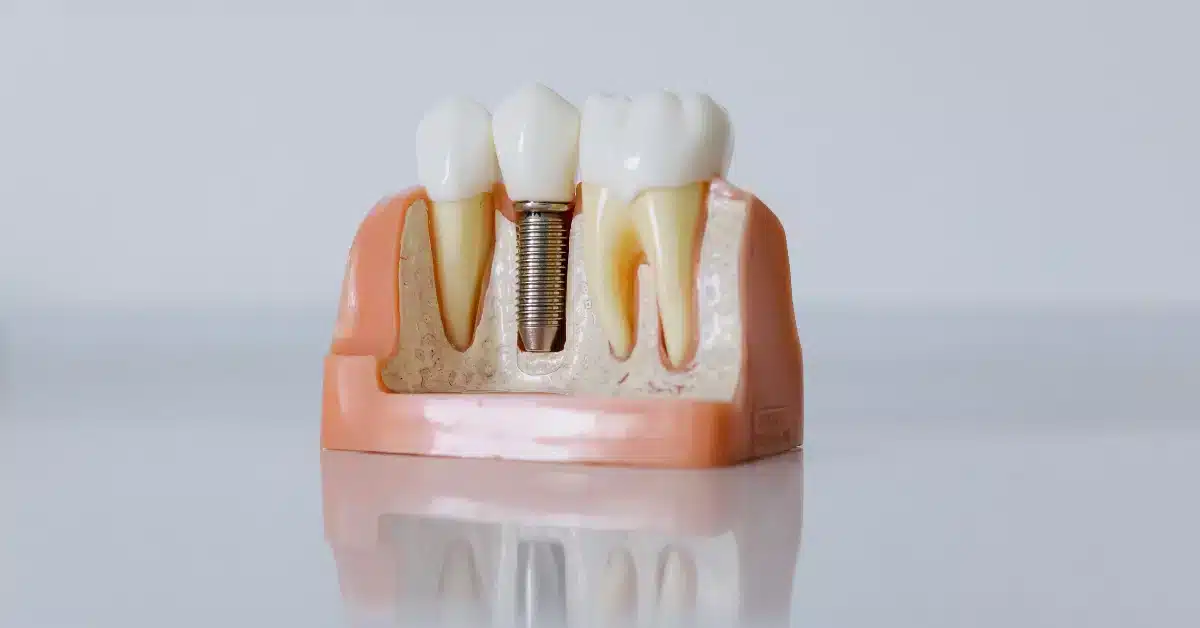
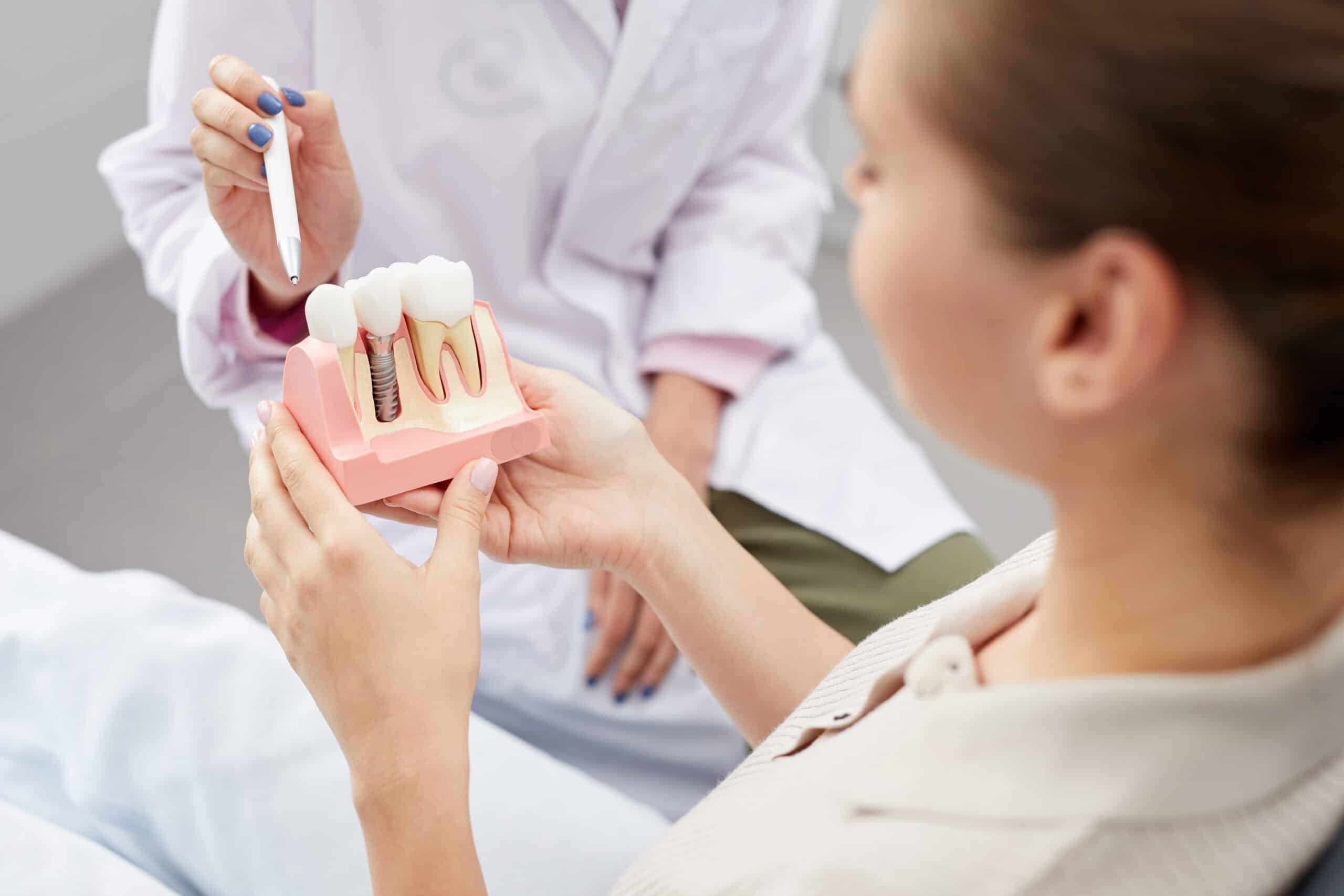
Think of an implant as two separate pieces. The fixture is a titanium screw about the size of a tooth root. Over three to six months, bone grows right up against its surface and locks it in. Whatever gets attached later, whether that’s one crown, a bridge, or a whole arch of teeth, is the restoration.
The fixture has no nerve, and it can’t get a cavity. Keep the bone and gum around it healthy and there’s no clock running on it. The restoration has it rougher. It takes every bite, grinds against the teeth opposite it, and soaks up whatever clenching you do at 3 a.m.
So when a friend says their implant failed after 12 years, ask which part failed. Quite often it was a worn crown that took one visit to replace, and the post underneath was fine.
| Restoration | Typical lifespan | What usually ends it |
|---|---|---|
| Implant post (fixture) | Decades; often for life | Infection around the implant, bone loss, overload |
| Crown on a single implant | About 10 to 15 years | Chipped porcelain, wear, a loosened screw |
| Full-arch implant teeth | Acrylic is often remade within 10 years; zirconia usually lasts longer | Tooth wear and fractures, often from grinding |
| Tooth-supported bridge | About 10 to 15 years | Decay or failure of the natural anchor teeth |
| Removable denture | Re-checked at 5 years, relined in between | Bone shrinkage, loose fit, worn teeth |
What the survival research actually shows
The most careful long-term review I know of pooled 18 prospective studies. It found 96.4% of implants still in place at 10 years (Howe and colleagues, 2019). The authors then corrected for patients who dropped out of those studies, and the estimate fell to 93.2%.
So how long do dental implants last in real patients rather than in a brochure? I trust the second number more. People who stop showing up for research follow-up aren’t a random group. Some of them left because something went wrong.
Two findings from that review matter if you’re over 65 and wondering how long dental implants last at your age:
-
- Patients 65 and older had 91.5% survival at 10 years, which works out to roughly double the loss rate of younger groups.
-
- Age by itself rarely rules anyone out. It tends to travel with other risks on this page, like diabetes, certain medications, and a longer history of gum disease.
For single-tooth implants, a systematic review summarized by the National Library of Medicine found 96.8% of implants and 94.5% of crowns survived five years. It also counted the problems that didn’t end in a lost implant. About 12.7% of crowns had a screw or abutment work loose, and 9.7% developed peri-implantitis or other soft-tissue trouble.
One more thing about these numbers. Survival and success are different words. An implant that’s still in your mouth but slowly losing bone counts as survived in most studies. When a practice quotes you a rate, ask which one it is.
What causes dental implant failure?
Dental implant failure tends to come in two waves. Early failures happen in the first few months, when bone never bonds to the post. Late failures show up years later, and they usually come down to the gum and bone around the implant, or to force.
Peri-implantitis
This is gum disease around an implant, and it’s behind more late failures than anything else. How common is it? When the Academy of Osseointegration and the American Academy of Periodontology pooled the research in 2025, about one patient in five had it (21%). Nearly half had mucositis, the early stage that can still be turned around.
Bleeding and puffy gum tissue show up first. Bone loss follows if it isn’t treated. People with a history of periodontitis carry more risk, which is why we treat gum disease before placing anything.
Smoking and vaping
Smokers fare worse, and it isn’t close. In a 2021 meta-analysis, their implants had 2.4 times the odds of failing. Few causes of dental implant failure have been studied as thoroughly. Even the FDA says smoking can slow healing and cut into long-term success. Quitting before surgery helps. Staying quit helps more.
Grinding and clenching
Bruxism pushes on an implant sideways, all night, for years. Pooled data put the odds of failure about 4.7 times higher in people who grind (Ionfrida and colleagues, 2024). It’s also the main reason full-arch teeth chip, and a common thread in late dental implant failure. A custom night guard costs far less than a new implant. Our guide to teeth grinding explains the warning signs.
Uncontrolled diabetes and other health conditions
Diabetes that’s well managed, with an A1C around 7% or lower, usually produces results close to those of non-diabetic patients. When A1C runs above 8%, reported implant survival drops to roughly 85% to 94% (Shahi and colleagues, 2026). Bone-density drugs, past radiation to the head or neck, and medications that suppress the immune system also belong in the planning conversation.
Poor planning or placement
An implant set at the wrong angle, crowded against a neighboring tooth, placed in too little bone, or loaded too soon starts out fighting physics. Provider choice can affect how a dentist plans surgery and follow-up care. Use our 7-point dental implant provider checklist to compare training, imaging, costs, and aftercare.
Ask for the numbers before you commit
At your consultation, Dr. Hendrickson will go through the risks that apply to your mouth specifically, and he’ll tell you how his own cases like yours have held up.
Request a consultation Call (702) 919-6206Signs of dental implant failure worth a call
Most signs of dental implant failure start out quiet. Call us if you notice any of these:
-
- Bleeding when you brush or floss around the implant
-
- Gum that looks red or swollen, or has pulled back far enough to show metal
-
- A bad taste or pus near the implant
-
- Any movement in the crown or the post, even slight
-
- New pain or pressure when you bite down
-
- A bite that suddenly feels off, or a crown that clicks
Movement matters most. A loose crown is often just a loose screw, and that’s a quick fix. A post that moves in the bone is more serious. The sooner we see it, the more options you have.
Maintenance that actually adds years
Daily cleaning is the foundation, and we cover that routine step by step in how to take care of your dental implants. Beyond brushing, three habits do the most to protect an implant:
-
- Professional cleanings every three to six months, with instruments that won’t scratch the implant surface
-
- An x-ray about once a year, which can catch signs of dental implant failure before you feel anything
-
- A night guard if you clench or grind, even a little
Keep the implant brand and model in your records, too. The FDA recommends it, and it makes repairs easier years from now. The crown on top ages much like a crown on a natural tooth, so our article on how long dental crowns last applies there as well.
Full-arch vs. single-tooth: why the lifespans differ
A full arch spreads your bite across four to six implants joined by one rigid bridge. That’s a real advantage. In a study that followed 561 patients and 2,364 implants for about nine years on average, 97.4% of upper-jaw implants and 98.9% of lower-jaw implants survived (Uesugi and colleagues, 2023).
So how long do dental implants last under a full arch? The posts hold up very well. The teeth on top are the weaker link. In a 2026 follow-up of 34 full-arch prostheses, every single arch had at least one minor problem by year six, mostly chipping and wear. Patients who probably ground their teeth accounted for 16 of the 25 arches that chipped or wore down.
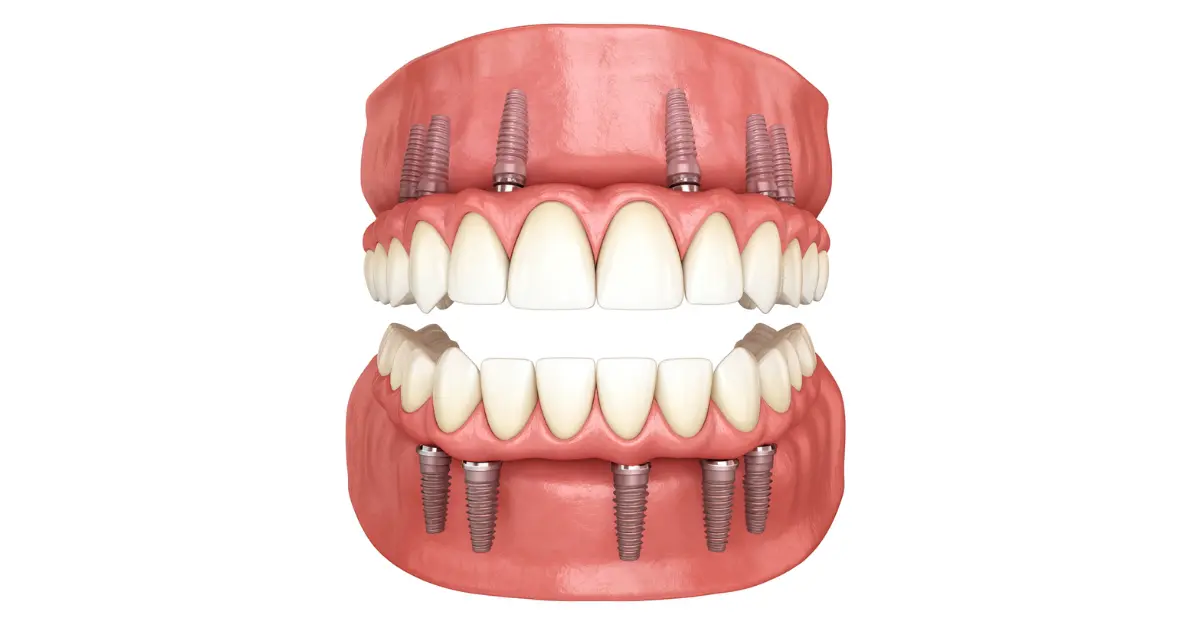
None of that means full-arch treatment is fragile. It means you should expect maintenance visits and plan for a remake of the teeth at some point. Our Hybridge full-arch restorations are planned with that upkeep in mind, and our full arch restoration guide walks through the whole process.
Are dental implants worth it?
On longevity alone, the comparison isn’t close. A bridge depends on two natural teeth that can still decay. Dentures sit on bone that keeps shrinking year after year, and the American College of Prosthodontists suggests having any denture checked once it’s past the five-year mark. An implant keeps loading the bone, and with care it usually outlasts both. For the full side-by-side, read dental implants vs. dentures.
So are dental implants worth it for everyone? Not always, at least not right away. A heavy smoker who won’t quit, an A1C well above 8%, or untreated gum disease can each tip the odds the wrong way. Those usually get addressed first. Once they are, the answer to “are dental implants worth it?” changes from maybe to yes for most people.
Cost is its own question. Our dental financing page explains the payment options.
What to ask a provider about their own success rate
Every implant office will tell you its success rate is high. Fine. Ask what that number actually counts.
-
- Of the implants you’ve placed, how many are still in at five years? At ten? How do you know?
-
- Is that a survival number or a success number?
-
- How many cases like mine (single tooth, full arch, grafted) did you do last year?
-
- Are you placing it yourself? And who makes the teeth?
-
- Say it fails in year one. Then what, and who pays for the redo?
-
- When the teeth on top wear out, what’s the plan?
A provider who tracks results can answer these without stalling. Dr. Gregg Hendrickson is a Diplomate of the American Board of Oral Implantology/Implant Dentistry, a Fellow of the AAID and ICOI, and a national trainer for Hybridge. He has completed thousands of implant and full-arch cases. Ask him these same questions. You can also read more about our Henderson dental implant center.
Quick answers to what patients ask me
How long do dental implants last in older adults?
Usually a long time. In the big 2019 review, 91.5% of implants in people 65 and up were still there at ten years. That’s a bit below younger patients, but I’d worry more about your medications and gum health than your birthday.Can a failed dental implant be replaced?
Often, yes. We take the old one out, clean the site, graft if it needs it, and wait a few months. Then a new implant goes in. Second tries don’t do quite as well as first ones, so we figure out why the first dental implant failure happened before trying again.Do dental implants last longer than bridges?
In most cases, yes. A bridge hangs on two natural teeth, and if either one decays or cracks, the whole bridge goes with it. An implant doesn’t lean on anything. Its crown still wears on roughly a bridge’s timeline, though.What is the most common cause of dental implant failure?
Depends on when. In the first few months it usually means the bone never bonded, and smoking, infection, or chewing too hard too soon are the usual suspects. Years later it’s almost always peri-implantitis, the implant version of gum disease.Will I need to replace my implant crown?
Probably, eventually. Ten to fifteen years is common before wear or chipping makes a new one worth it. It’s a routine visit, and the post in the bone doesn’t get touched.Are dental implants worth it if I’m in my 70s or 80s?
For a lot of people, yes. I place implants for patients in their 80s, often just two of them to lock down a denture that’s been sliding around for years. Healing, bone, and medications decide it. Age mostly doesn’t.Get a lifespan estimate for your own mouth
Every number on this page came from thousands of other people’s mouths. Yours is the one that matters. A 3D scan and an exam show me which of these risks you actually have, and what we’d fix before placing anything. That’s the only fair way to answer “how long do dental implants last?” for you.
Call our Henderson office at (702) 919-6206, or reach us online, and ask for an implant consultation. Bring recent x-rays if you have them, plus your medication list. You’ll get a straight answer, even if it’s not the one you hoped for.
Schedule your consultation Call (702) 919-6206