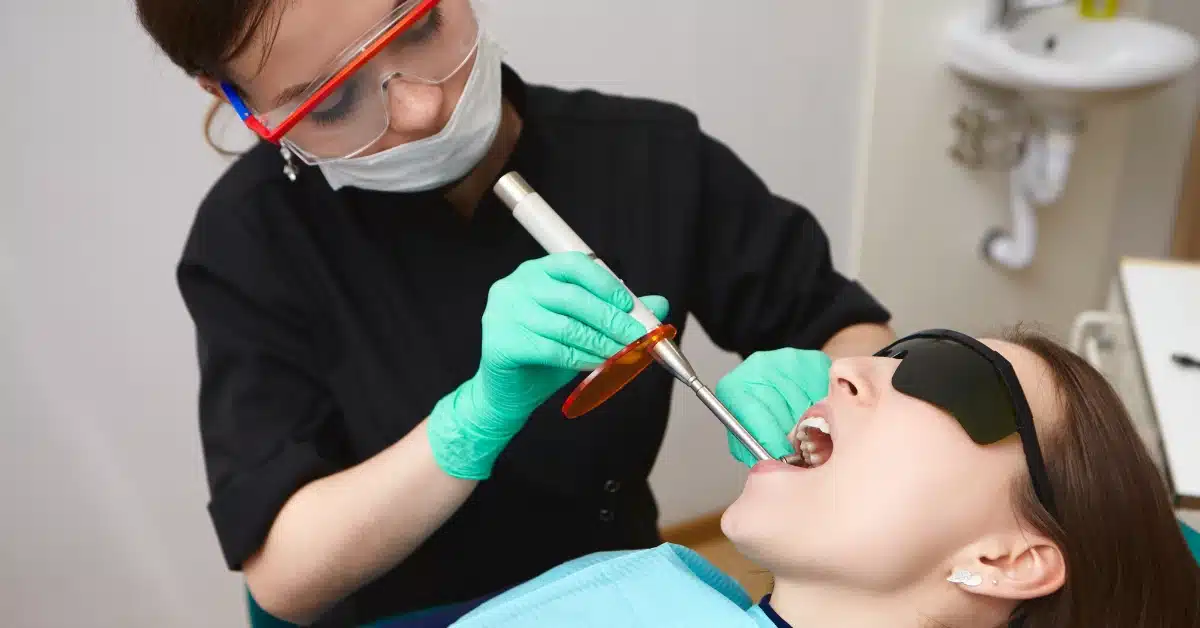
LANAP Laser Gum Treatment: Gum Disease Surgery Without the Scalpel
Gum surgery. Two words that can stop a patient cold. The mental image arrives immediately – scalpels, stitches, swollen gums, a week of soft foods and careful rinsing. You know you need treatment. Your dentist has made that clear. But the thought of traditional periodontal surgery feels like more than you’re ready to sign up for.
What if there’s a different path? LANAP laser gum treatment – Laser-Assisted New Attachment Procedure – has changed the conversation around gum disease surgery in a way that’s genuinely worth understanding. Not as a gimmick or a marketing claim, but as a clinically validated treatment that addresses the same serious disease through a fundamentally different mechanism. One that doesn’t involve cutting your gums.
If you’re a Henderson or Las Vegas patient with moderate to severe periodontal disease who was told surgery was necessary, this article is written specifically for you.
Why Gum Disease Gets to the Point of Needing Surgery
Periodontal disease is a bacterial infection of the structures supporting your teeth – the gums, ligaments, and bone. It begins as gingivitis, the reversible inflammation most people have experienced. Left untreated, it progresses to periodontitis, where the infection destroys the connective tissue and bone that hold teeth in place.
By the time surgery is recommended, the infection has typically created deep pockets between the gum and the tooth root – spaces so deep that regular professional cleanings can no longer reach the bacteria colonizing the bottom of those pockets. According to the American Academy of Periodontology, periodontal pockets deeper than 5mm frequently require surgical intervention to fully decontaminate and allow the tissue to heal properly.
That’s the clinical reality. The question is what kind of intervention gives you the best outcome with the least disruption to your life.
Traditional Gum Surgery: What It Actually Involves
Osseous surgery – the conventional surgical approach to advanced gum disease – has been performed for decades and produces well-documented results. Understanding exactly what it involves helps clarify why so many patients put off necessary treatment, and why alternatives matter.
In traditional gum surgery, the periodontist administers local anesthesia, then makes incisions along the gumline to fold back the gum tissue like a flap. This exposes the tooth roots and underlying bone directly, allowing the surgeon to manually remove diseased tissue, scrape bacterial deposits from the roots, and reshape the bone if needed. The flap is then sutured back into place, typically at a lower position to reduce pocket depth.
It’s effective. But the recovery is real – swelling, soreness, and dietary restrictions for a week to ten days are standard. Most patients need at least several days away from work. Sensitivity increases as root surfaces that were previously covered by gum tissue are now exposed. And the psychological barrier of knowingly consenting to your gums being cut is enough to cause many patients to delay treatment they genuinely need.
LANAP Laser Gum Treatment: How the Laser Works Differently
LANAP uses a specific wavelength laser – the PerioLase MVP-7, which operates at a 1064 nanometer Nd:YAG wavelength – that interacts differently with diseased tissue than it does with healthy tissue. That selectivity is the foundation of why the procedure works without cutting.
The procedure works in several stages. The laser fiber – about the diameter of three human hairs – is inserted into the periodontal pocket alongside the tooth root. As it passes through the pocket, the laser energy selectively destroys the bacteria and diseased tissue lining the pocket while leaving healthy gum tissue largely intact. The laser also coagulates the blood at the site, creating a stable clot that seals the pocket and forms the foundation for healing and tissue reattachment.
The roots are then cleaned with ultrasonic instruments to remove calculus deposits. The laser is used a second time to further stimulate the clot and compress it against the root, creating what’s called a “gel clot” – a stable environment that allows the regeneration of the attachment between gum and tooth. Research published in the International Journal of Periodontics and Restorative Dentistry has shown that LANAP can stimulate regeneration of bone and connective tissue, not merely stop the disease from progressing.
No incisions. No sutures. No flap reflected away from your teeth.
LANAP vs. Traditional Gum Surgery: A Direct Comparison
| Factor | Traditional Osseous Surgery | LANAP Laser Treatment |
|---|---|---|
| Incisions | Yes – scalpel used to cut gum tissue | No – laser fiber enters existing pocket |
| Sutures | Yes – required to close flap | No sutures needed |
| Anesthesia | Local anesthesia (injections) | Local anesthesia (injections) |
| Gum recession post-treatment | Common – flap repositioned lower | Minimal – tissue preserved |
| Return to work | Several days to one week | Usually next day |
| Post-op discomfort | Significant – swelling, soreness typical | Mild – most patients report minimal pain |
| Dietary restrictions | Soft foods for 1-2 weeks | Soft foods for 24-48 hours |
| Bone regeneration potential | Limited without additional grafting | Stimulates natural regeneration |
| Bacterial reduction | Mechanical removal | Laser kills bacteria directly |
| FDA clearance | Established | FDA cleared for periodontal treatment |
What Recovery Actually Looks Like With LANAP
Recovery is where the patient experience of LANAP diverges most dramatically from traditional surgery. Here’s a realistic timeline of what most patients report:
- Day of treatment. The procedure itself typically takes two appointments of approximately two hours each, treating one half of the mouth per session. You go home the same day. Most patients describe the experience as significantly less stressful than anticipated. Mild soreness and some blood-tinged saliva are normal for the first several hours.
- Day 1-2. Most patients return to work the day after LANAP treatment. Soft foods are recommended for 24 to 48 hours. Over-the-counter pain medication handles any residual discomfort for the majority of patients – prescription pain management is rarely needed.
- Week 1-2. The gel clot that forms in the treated pockets is fragile during this window. Patients are instructed to avoid flossing the treated areas and to use a prescribed rinse to keep the site clean without disturbing healing. You’ll notice the gums may look slightly different as healing begins.
- 4-6 weeks. The treated pockets are re-evaluated. Research on LANAP outcomes shows measurable pocket depth reduction and clinical attachment gain at this stage.
- 3-6 months. Radiographic evidence of bone fill at the treated sites often becomes visible in patients who were appropriate LANAP candidates. This regenerative potential – not just arresting disease but actually rebuilding what was lost – is one of the most clinically significant aspects of the procedure.
Who Is a Good Candidate for LANAP Laser Gum Treatment?
LANAP isn’t the right tool for every patient with gum disease. The candidacy criteria matter, and an honest evaluation is necessary before recommending this approach over conventional surgery.
Patients who typically do well with LANAP include:
- Moderate to severe periodontitis with pocket depths of 5mm or greater. Mild gum disease responds well to scaling and root planing alone – surgery of any kind is generally unnecessary at that stage. LANAP is best suited to the more advanced cases where deeper intervention is genuinely needed.
- Patients with systemic health factors that complicate healing. Because LANAP doesn’t involve incisions, it’s particularly well-suited for patients with diabetes, cardiovascular disease, or blood thinners that make traditional surgical healing more complicated. The laser’s natural coagulation effect reduces bleeding risk.
- Patients who have avoided needed treatment due to fear. This is, frankly, one of the most important candidacy factors. Patients who have been putting off periodontal treatment because of surgery anxiety are far more likely to follow through with LANAP – and treatment completed is always better than treatment deferred.
- Patients with adequate remaining bone support. While LANAP stimulates regeneration, it requires some existing bone architecture to work with. In severely advanced cases where bone loss is extensive, a combined approach may still be needed.
LANAP is generally not the best option when:
- Gum disease is mild enough that deep cleaning alone can address it
- Severe anatomical factors require direct surgical access to reshape bone
- There are other structural issues (gum grafting needs, for example) that require a surgical approach regardless
Our perioscopy service is another minimally invasive deep cleaning option for patients in the earlier stages of disease – worth discussing if you’re not yet at the point of requiring LANAP-level intervention.
The Cost Question: Is LANAP More Expensive?
Cost is one of the first questions patients ask, and the answer is more straightforward than most people expect. LANAP and traditional osseous surgery are often comparable in total cost – typically ranging from $1,000 to $4,000 depending on the extent of disease, the number of teeth involved, and your insurance coverage.
Many dental insurance plans that cover traditional periodontal surgery will cover LANAP at similar benefit levels, since both address the same diagnosed condition. It’s worth calling your insurance provider with the specific procedure codes – D4341 for scaling and root planing and D4261/D4262 for osseous surgery or laser equivalents – to understand your specific coverage before your consultation.
The cost comparison over time also favors LANAP’s regenerative outcomes. Traditional surgery reduces pocket depth primarily by repositioning the gum tissue lower – which controls the disease but doesn’t rebuild what was lost. When LANAP stimulates bone and attachment regeneration, you’re not just stopping the damage. You’re potentially recovering some of what periodontal disease took, which reduces the likelihood of future extensive intervention.
A Modern Solution to a Disease That’s Been Damaging Smiles for Decades
Periodontal disease affects nearly half of American adults over 30, and severe periodontitis affects about 9% of the adult population according to the CDC. For decades, the options were limited to living with the disease or accepting traditional surgery. The psychological barrier of that second option kept – and still keeps – many patients in a cycle of delay that allows their disease to worsen.
LANAP represents something genuinely different. Not a workaround or a compromise, but a clinically validated alternative that addresses the same serious disease with a fundamentally different approach. The laser doesn’t just avoid the discomfort of traditional surgery – it works through a mechanism that promotes regeneration, reduces bacterial load in a way that mechanical debridement alone cannot match, and allows most patients to return to normal life the following day.
If you’ve been told you need gum surgery and the thought has been holding you back from making the call, this is worth a conversation. At our Henderson practice, we offer advanced laser technology and a thorough evaluation to determine whether LANAP is the right approach for your specific case – and if it isn’t, we’ll tell you that honestly and explain why.
Your gum disease won’t wait. But the treatment doesn’t have to be what you’re afraid it is. Contact Comprehensive Dental Care to schedule a periodontal evaluation and find out whether LANAP laser gum treatment is right for you.
This article is for educational purposes only and does not constitute medical or dental advice. Candidacy for LANAP or any periodontal treatment should be determined by a licensed dental professional following a clinical examination.
LANAP Laser Gum Treatment FAQs
What is LANAP laser gum treatment and how is it different from traditional gum surgery?
LANAP (Laser-Assisted New Attachment Procedure) treats advanced gum disease using a hair-thin laser fiber inserted into periodontal pockets — no scalpel, no stitches. The 1064nm Nd:YAG laser selectively destroys bacteria and diseased tissue while preserving healthy gum tissue, then stimulates a healing clot that promotes bone and connective tissue regeneration. Traditional osseous surgery cuts and folds back the gum flap for mechanical cleaning. LANAP achieves comparable results with significantly less trauma and faster recovery.
How long is recovery after LANAP compared to traditional gum surgery?
Most LANAP patients return to work the next day. Soft foods are recommended for just 24–48 hours, and over-the-counter pain relief is typically sufficient. Traditional gum surgery involves swelling, soreness, and dietary restrictions lasting one to two weeks, with most patients needing several days away from work. The difference in downtime is one of the most significant practical advantages of choosing LANAP over conventional periodontal surgery.
Who is a good candidate for LANAP laser gum treatment?
LANAP is best suited for patients with moderate to severe periodontitis — pocket depths of 5mm or greater — who need deeper intervention than scaling and root planing alone. It’s especially well-suited for patients with diabetes, cardiovascular disease, or blood-thinning medications that complicate surgical healing, as well as patients who have been avoiding needed treatment due to surgery anxiety. Mild gum disease typically doesn’t require LANAP, and severely advanced bone loss may still need a combined surgical approach.
Does insurance cover LANAP laser gum treatment?
Many dental insurance plans that cover traditional osseous surgery will cover LANAP at similar benefit levels, since both treat the same diagnosed condition. When checking coverage, ask your insurer about procedure codes D4341 (scaling and root planing) and D4261/D4262 (osseous surgery or laser equivalents). Total costs for LANAP and traditional surgery are often comparable, ranging from $1,000 to $4,000 depending on disease extent and the number of teeth involved.
Can LANAP actually rebuild lost bone, or does it just stop gum disease from getting worse?
Unlike traditional surgery, which primarily controls disease by repositioning gum tissue lower, LANAP has demonstrated the ability to stimulate regeneration of bone and connective tissue attachment. Research published in peer-reviewed literature shows measurable bone fill at treated sites visible on X-rays at 3–6 months post-treatment in appropriate candidates. This regenerative potential is clinically significant — it means some patients recover structure that periodontal disease had already destroyed, not just halt further loss.
How common is gum disease, and at what point does it require surgical treatment?
The CDC reports that nearly half of American adults over 30 have some form of periodontal disease, with severe periodontitis affecting approximately 9% of the adult population. Surgical intervention — whether traditional or laser-based — is typically recommended when pocket depths exceed 5mm, because bacteria colonizing those depths can no longer be reached by standard professional cleanings. At that stage, deeper decontamination is necessary to stop progressive bone and tissue loss.